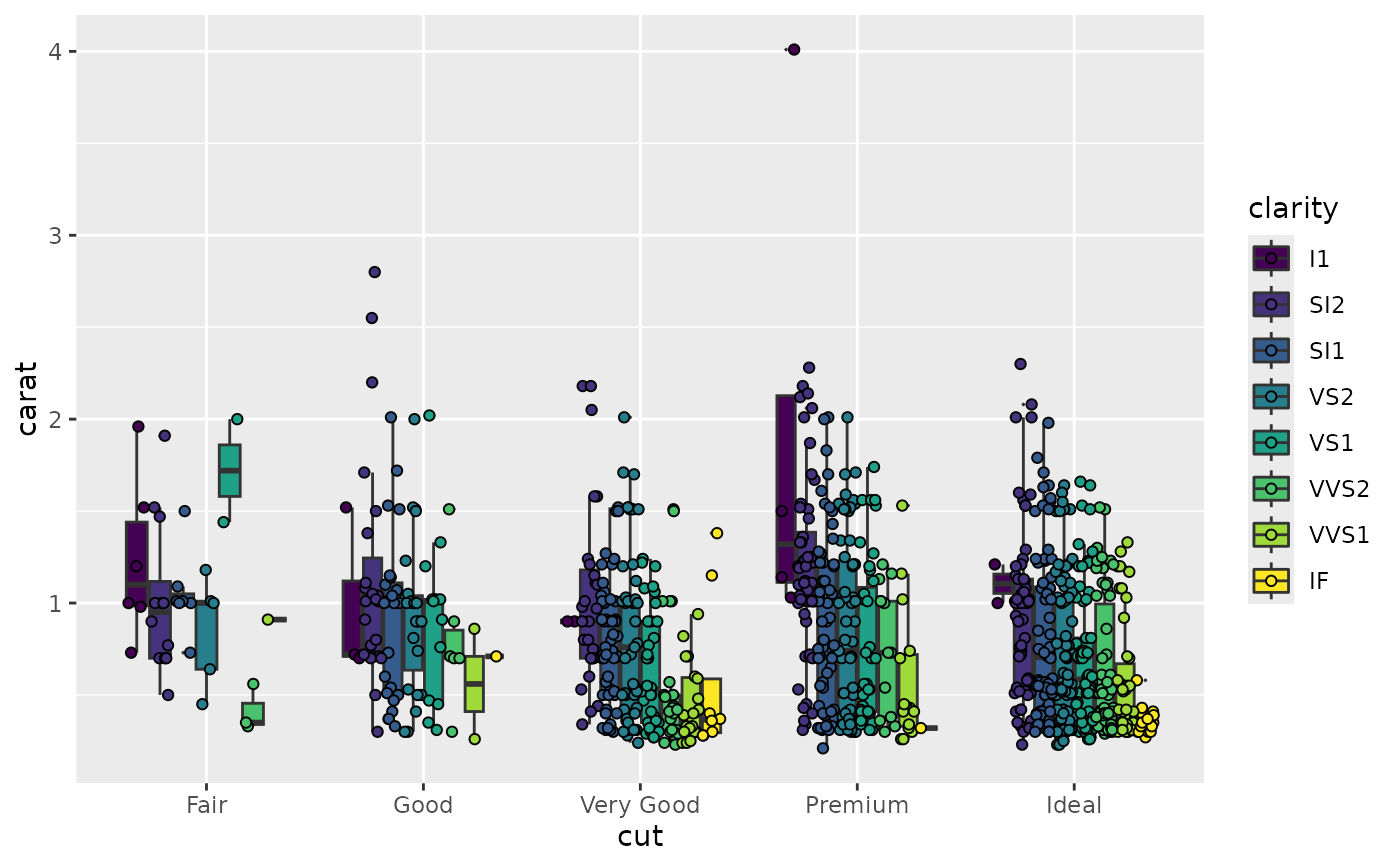
This is primarily used for aligning points generated through
geom_point() with dodged boxplots (e.g., a geom_boxplot() with
a fill aesthetic supplied).
Usage
position_jitterdodge(
  jitter.width = NULL,
  jitter.height = 0,
  dodge.width = 0.75,
  reverse = FALSE,
  preserve = "total",
  seed = NA
)
Arguments
- jitter.width
degree of jitter in x direction. Defaults to 40% of the resolution of the data.
- jitter.height
degree of jitter in y direction. Defaults to 0.
- dodge.width
the amount to dodge in the x direction. Defaults to 0.75, the default
position_dodge()width.- reverse
If
TRUE, will reverse the default stacking order. This is useful if you're rotating both the plot and legend.- preserve
Should dodging preserve the
"total"width of all elements at a position, or the width of a"single"element?- seed
A random seed to make the jitter reproducible. Useful if you need to apply the same jitter twice, e.g., for a point and a corresponding label. The random seed is reset after jittering. If
NA(the default value), the seed is initialised with a random value; this makes sure that two subsequent calls start with a different seed. UseNULLto use the current random seed and also avoid resetting (the behaviour of ggplot 2.2.1 and earlier).
See also
Other position adjustments:
position_dodge(),
position_identity(),
position_jitter(),
position_nudge(),
position_stack()
Examples
set.seed(596)
dsub <- diamonds[sample(nrow(diamonds), 1000), ]
ggplot(dsub, aes(x = cut, y = carat, fill = clarity)) +
  geom_boxplot(outlier.size = 0) +
  geom_point(pch = 21, position = position_jitterdodge())